


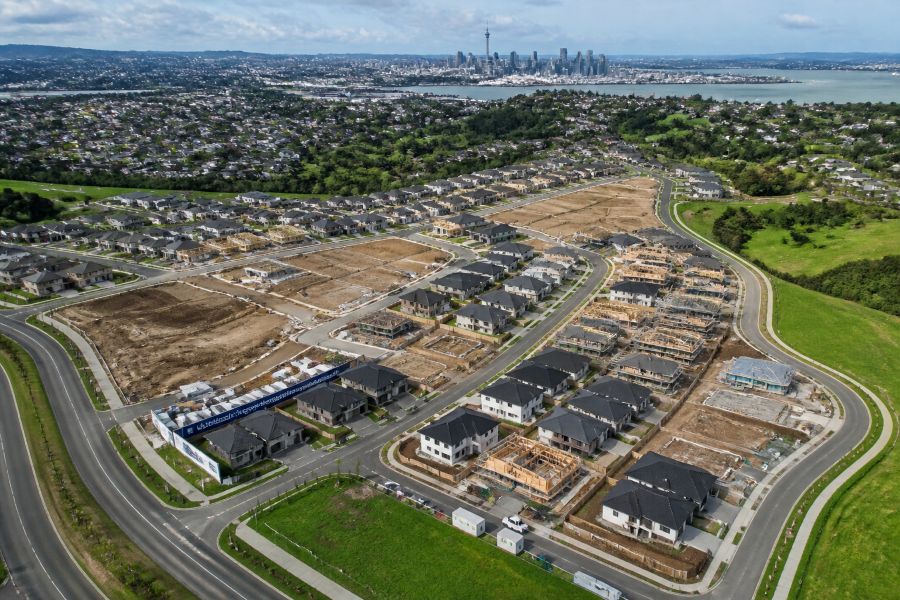
Auckland is increasingly invoked as the definitive case for blanket upzoning in Australia.
Auckland is increasingly invoked as the definitive case for blanket upzoning in Australia. Whenever economists or supply-side commentators argue for broadscale upzoning across cities to solve the housing crisis, Auckland is invariably presented as the proof point. ‘Upzone everywhere, sweep away planning controls, and the market will deliver the housing supply we need’.
The story is simple, persuasive and increasingly influential. It is also a remarkably selective reading of what really happened in Auckland.
At the recent National Planning Congress in Canberra, Auckland Council’s General Manager of Planning finally set the record straight on what actually drove Auckland’s housing outcomes. We heard that Auckland’s housing reforms emerged from one of the most ambitious programs of metropolitan strategic planning and governance reform undertaken anywhere in Australasia in recent decades.
Before Auckland expanded housing capacity at scale, it fundamentally restructured how the city governed growth. Councils were consolidated into a single metropolitan authority. A long-term spatial plan, developed through significant community consultation, established a “quality compact city” vision to concentrate future growth around centres, rapid transit and coordinated urban development.
The scale of change was substantial. Almost one million new homes in existing residential areas were planned for through the Auckland Unitary Plan in 2016, with significant uplift concentrated around metropolitan centres, town centres and transport corridors where accessibility, infrastructure and demand could support substantial additional growth.
Cities do not grow everywhere all at once
The reforms concentrated significant housing capacity around well-connected parts of the city rather than dispersing density across the urban area.
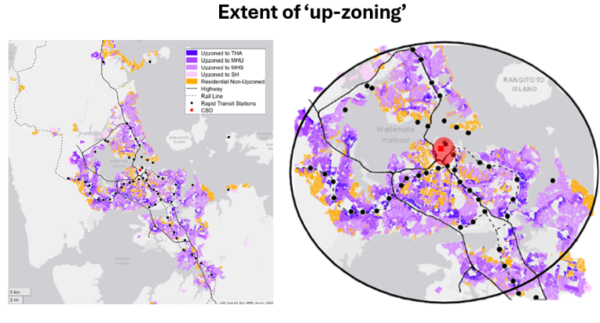
Source: Ryan Greenaway-McGrevy and James Allan Jones (2025) “Can zoning reform change urban development patterns? Evidence from Auckland”, Urban Studies, Vol. 62(12), https://doi.org/10.1177/00420980241311521
Auckland Council itself described the objective as making better use of “well-connected, high demand land”.
Height limits increased most significantly in areas with strong transport access and existing urban services. Planning controls were simplified to deliver on the vision, approval pathways streamlined where development was low-risk, design considerations embedded, and parking requirements reformed in locations well-served by centres and public transport. The reforms sat within a much larger effort to coordinate infrastructure, transport investment, urban form and housing growth across the metropolitan area.
Importantly, despite the scale of reform, a substantial proportion of Auckland was not upzoned, due to heritage, environmental values, topography, natural hazards, or other important planning reasons. While around 70 per cent of residential land was upzoned through the Unitary Plan, approximately a quarter of Auckland’s residential areas remained zoned for low-density suburban residential.
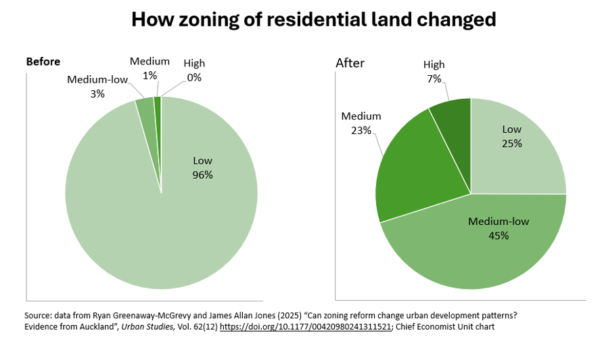
That is not a story of blanket upzoning. It is a story about metropolitan-scale strategic planning.
Everything should be made as simple as possible, but not simpler
Yet much of the current debate reduces all of this to a single conclusion: Auckland merely upzoned extensively, housing supply increased, therefore Australia should broadly upzone its suburbs too.
In some parts of the housing debate, Auckland has become less a case study and more a symbol – used to support a broader ideological argument that cities simply need less planning. But the closer one looks at Auckland itself, the harder it becomes to separate its housing outcomes from the strategic planning framework that shaped them.
Indeed, the Auckland story is increasingly being simplified beyond the point where the explanation matches the reality.
Cities are not abstract economic models. They are physical systems with infrastructure constraints, transport networks, climate risks, funding limitations and communities that experience the consequences of poorly coordinated growth long after the headlines move on.
One of the striking features of the current “upzone everything” argument is how little attention it gives to the infrastructure question. Building new homes puts significant pressure on infrastructure networks like transport systems, drainage, schools, open space, sewerage and utilities. Building homes in established areas can reduce infrastructure costs by around $75,000 per dwelling compared with greenfield development, but only when it’s planned and sequenced well[1].
Auckland’s reforms worked alongside metropolitan-scale coordination precisely because substantial growth requires sequencing, infrastructure investment and long-term planning.
The same applies to climate resilience and risk. Many established suburbs already face growing exposure to flooding, heat and bushfire risk, pressures that become even more significant as density increases. Natural disasters currently cost the Australian economy around $38 billion per year, projected to rise to $73 billion annually by 2060[2]. Growth decisions made now shape how safe homes are to live in, how vulnerable infrastructure is, whether insurance is available, and long-term community resilience for decades to come.
There is also the issue of certainty, something often overlooked in theoretical housing debates but fundamental to delivery in practice. Cities undergoing large-scale urban change require confidence that infrastructure will arrive, transport investment will follow, and the broader growth framework will remain coherent over time. Developers and investors make long-term decisions based on that certainty. When the planning framework is clear, sequenced and credible, it gives the private sector greater confidence to commit capital, bring forward projects and deliver homes.
Communities also respond to that certainty. Where significant growth or upzoning is not matched by delivered infrastructure, community resistance intensifies and political pressure quickly follows. Over time, that can make reform politically fragile, with governments retreating from or watering down changes that were intended to support long-term housing supply and urban growth.
Auckland grew through planning, not despite it
The city’s reforms clearly increased housing supply. Between 2016 and 2022, Auckland’s housing construction rates rose sharply, with consenting reaching record highs. More homes were built, particularly around existing centres and transport infrastructure, and rental pressures moderated relative to comparable locations. However, housing affordability pressures remain in Auckland, with a medium house price to medium household income ratio of 7.4 today. Lower than the peak of 10.8 in 2021, but still considerably higher than Auckland’s ratio of 5.0 in the late 1990s and early 2000s.[3]
But the geography of that growth is equally important.
A significant proportion of post-reform housing delivery occurred within relatively close proximity to the city centre and around existing transport and infrastructure networks. Growth largely followed the metropolitan structure established through upfront strategic planning.
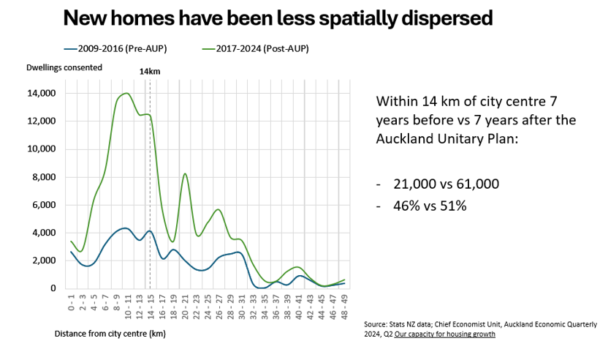
That pattern reflects years of work aligning urban structure, governance, transport and planning policy in the same direction.
Much of the current housing debate frames planning primarily as a barrier to housing supply, as though the central challenge facing cities is simply enabling more theoretical development capacity. But Auckland points to something more fundamental. Housing supply increased because the city approached growth as a coordinated metropolitan housing agenda, rather than as a stand-alone zoning exercise.
Australia unquestionably needs to build more homes. But the Auckland experience does not support the idea that blanket upzoning is the solution. Rather, good strategic planning is.
The moment growth becomes detached from place, the politics changes
New Zealand’s subsequent experience makes the distinction between planning-led growth and broad deregulation even clearer.
The original Auckland Unitary Plan reforms were built on years of metropolitan-scale strategic planning. Growth was deliberately concentrated where it made sense: around centres, rapid transit and existing infrastructure, and away from high-risk areas of hazards, and other sensitive lands. The reforms sat within a coherent spatial strategy, backed by governance reform, infrastructure planning and a long-term vision for how Auckland would evolve as a city.
The upzoning was significant, but it was also targeted, sequenced and embedded within a broader city-shaping agenda.
Following the success of Auckland’s planning reforms, central government then moved to impose far more permissive density settings nationally through the Medium Density Residential Standards. Unlike the original Auckland reforms, these changes were not grounded in detailed metropolitan spatial planning or tied closely to local infrastructure capacity, transport accessibility or urban structure. Medium-density permissions were proposed to apply far more broadly through a standardised national approach.
Unsurprisingly, those later reforms quickly became politically contested and were subsequently softened or made optional.
The contrast is revealing.
None of this suggests national governments should step away from housing reform. In fact, national leadership remains critical in setting clear expectations, incentivising best practice, investing in catalytic city-shaping infrastructure, and partnering with other levels of government and industry to deliver growth that is both substantial and strategically grounded.
The original Auckland reforms held together because they formed part of a coordinated vision for how the city would function and grow over time. Housing growth was concentrated in well-located areas, and coordinated with transport investment, centres policy, infrastructure planning and the metropolitan urban structure. The later proposed reforms were increasingly perceived as density detached from place, infrastructure and long-term city-shaping outcomes.
The importance of well-planned growth
This reinforces that when the policy pendulum starts swinging between a deregulation agenda and political retreat, confidence deteriorates rapidly. Developers become less certain about long-term settings, infrastructure planning becomes harder to sequence, communities become more resistant to future change, and governments lose the stability needed to sustain reform over time.
Cities absorb growth over decades, not electoral cycles. Large-scale urban change requires confidence that infrastructure, transport, public space, services and housing are evolving together in a coherent way. When growth begins to feel disconnected from infrastructure, accessibility or the broader structure of the city, political support becomes fragile and reform itself becomes much harder to sustain.
The economic context is also worth noting. Auckland’s reforms occurred during a very different construction and financing environment from the one facing Australian cities today. Higher construction costs, tighter lending conditions and reduced development margins are now affecting housing delivery across the board, regardless of zoning capacity alone.
The Auckland story was never simply about allowing more density. It was about using strategic planning to determine where substantial growth could strengthen the city, support productivity, improve accessibility and make better use of existing infrastructure.
Australia unquestionably needs more homes. But the important lesson from Auckland is that durable housing growth depends on strategic planning that gives communities, governments and investors confidence about where growth will occur and how cities will support it over time.
[1] NSW Productivity Commission, 2023 Building more homes where infrastructure costs less | NSW Government
[2] Deloitte Access, 2021, Update to the economic costs of natural disasters in Australia
[3] From data produced by REINZ, Stats NZ, Chief Economist Unit Auckland Council
Auckland is increasingly invoked as the definitive case for blanket upzoning in Australia. Whenever economists or supply-side commentators argue for broadscale upzoning across cities to solve the housing crisis, Auckland is invariably presented as the proof point. ‘Upzone everywhere, sweep away planning controls, and the market will deliver the housing supply we need’.
The story is simple, persuasive and increasingly influential. It is also a remarkably selective reading of what really happened in Auckland.
At the recent National Planning Congress in Canberra, Auckland Council’s General Manager of Planning finally set the record straight on what actually drove Auckland’s housing outcomes. We heard that Auckland’s housing reforms emerged from one of the most ambitious programs of metropolitan strategic planning and governance reform undertaken anywhere in Australasia in recent decades.
Before Auckland expanded housing capacity at scale, it fundamentally restructured how the city governed growth. Councils were consolidated into a single metropolitan authority. A long-term spatial plan, developed through significant community consultation, established a “quality compact city” vision to concentrate future growth around centres, rapid transit and coordinated urban development.
The scale of change was substantial. Almost one million new homes in existing residential areas were planned for through the Auckland Unitary Plan in 2016, with significant uplift concentrated around metropolitan centres, town centres and transport corridors where accessibility, infrastructure and demand could support substantial additional growth.
Cities do not grow everywhere all at once
The reforms concentrated significant housing capacity around well-connected parts of the city rather than dispersing density across the urban area.
Source: Ryan Greenaway-McGrevy and James Allan Jones (2025) “Can zoning reform change urban development patterns? Evidence from Auckland”, Urban Studies, Vol. 62(12), https://doi.org/10.1177/00420980241311521
Auckland Council itself described the objective as making better use of “well-connected, high demand land”.
Height limits increased most significantly in areas with strong transport access and existing urban services. Planning controls were simplified to deliver on the vision, approval pathways streamlined where development was low-risk, design considerations embedded, and parking requirements reformed in locations well-served by centres and public transport. The reforms sat within a much larger effort to coordinate infrastructure, transport investment, urban form and housing growth across the metropolitan area.
Importantly, despite the scale of reform, a substantial proportion of Auckland was not upzoned, due to heritage, environmental values, topography, natural hazards, or other important planning reasons. While around 70 per cent of residential land was upzoned through the Unitary Plan, approximately a quarter of Auckland’s residential areas remained zoned for low-density suburban residential.
That is not a story of blanket upzoning. It is a story about metropolitan-scale strategic planning.
Everything should be made as simple as possible, but not simpler
Yet much of the current debate reduces all of this to a single conclusion: Auckland merely upzoned extensively, housing supply increased, therefore Australia should broadly upzone its suburbs too.
In some parts of the housing debate, Auckland has become less a case study and more a symbol – used to support a broader ideological argument that cities simply need less planning. But the closer one looks at Auckland itself, the harder it becomes to separate its housing outcomes from the strategic planning framework that shaped them.
Indeed, the Auckland story is increasingly being simplified beyond the point where the explanation matches the reality.
Cities are not abstract economic models. They are physical systems with infrastructure constraints, transport networks, climate risks, funding limitations and communities that experience the consequences of poorly coordinated growth long after the headlines move on.
One of the striking features of the current “upzone everything” argument is how little attention it gives to the infrastructure question. Building new homes puts significant pressure on infrastructure networks like transport systems, drainage, schools, open space, sewerage and utilities. Building homes in established areas can reduce infrastructure costs by around $75,000 per dwelling compared with greenfield development, but only when it’s planned and sequenced well[1].
Auckland’s reforms worked alongside metropolitan-scale coordination precisely because substantial growth requires sequencing, infrastructure investment and long-term planning.
The same applies to climate resilience and risk. Many established suburbs already face growing exposure to flooding, heat and bushfire risk, pressures that become even more significant as density increases. Natural disasters currently cost the Australian economy around $38 billion per year, projected to rise to $73 billion annually by 2060[2]. Growth decisions made now shape how safe homes are to live in, how vulnerable infrastructure is, whether insurance is available, and long-term community resilience for decades to come.
There is also the issue of certainty, something often overlooked in theoretical housing debates but fundamental to delivery in practice. Cities undergoing large-scale urban change require confidence that infrastructure will arrive, transport investment will follow, and the broader growth framework will remain coherent over time. Developers and investors make long-term decisions based on that certainty. When the planning framework is clear, sequenced and credible, it gives the private sector greater confidence to commit capital, bring forward projects and deliver homes.
Communities also respond to that certainty. Where significant growth or upzoning is not matched by delivered infrastructure, community resistance intensifies and political pressure quickly follows. Over time, that can make reform politically fragile, with governments retreating from or watering down changes that were intended to support long-term housing supply and urban growth.
Auckland grew through planning, not despite it
The city’s reforms clearly increased housing supply. Between 2016 and 2022, Auckland’s housing construction rates rose sharply, with consenting reaching record highs. More homes were built, particularly around existing centres and transport infrastructure, and rental pressures moderated relative to comparable locations. However, housing affordability pressures remain in Auckland, with a medium house price to medium household income ratio of 7.4 today. Lower than the peak of 10.8 in 2021, but still considerably higher than Auckland’s ratio of 5.0 in the late 1990s and early 2000s.[3]
But the geography of that growth is equally important.
A significant proportion of post-reform housing delivery occurred within relatively close proximity to the city centre and around existing transport and infrastructure networks. Growth largely followed the metropolitan structure established through upfront strategic planning.
That pattern reflects years of work aligning urban structure, governance, transport and planning policy in the same direction.
Much of the current housing debate frames planning primarily as a barrier to housing supply, as though the central challenge facing cities is simply enabling more theoretical development capacity. But Auckland points to something more fundamental. Housing supply increased because the city approached growth as a coordinated metropolitan housing agenda, rather than as a stand-alone zoning exercise.
Australia unquestionably needs to build more homes. But the Auckland experience does not support the idea that blanket upzoning is the solution. Rather, good strategic planning is.
The moment growth becomes detached from place, the politics changes
New Zealand’s subsequent experience makes the distinction between planning-led growth and broad deregulation even clearer.
The original Auckland Unitary Plan reforms were built on years of metropolitan-scale strategic planning. Growth was deliberately concentrated where it made sense: around centres, rapid transit and existing infrastructure, and away from high-risk areas of hazards, and other sensitive lands. The reforms sat within a coherent spatial strategy, backed by governance reform, infrastructure planning and a long-term vision for how Auckland would evolve as a city.
The upzoning was significant, but it was also targeted, sequenced and embedded within a broader city-shaping agenda.
Following the success of Auckland’s planning reforms, central government then moved to impose far more permissive density settings nationally through the Medium Density Residential Standards. Unlike the original Auckland reforms, these changes were not grounded in detailed metropolitan spatial planning or tied closely to local infrastructure capacity, transport accessibility or urban structure. Medium-density permissions were proposed to apply far more broadly through a standardised national approach.
Unsurprisingly, those later reforms quickly became politically contested and were subsequently softened or made optional.
The contrast is revealing.
None of this suggests national governments should step away from housing reform. In fact, national leadership remains critical in setting clear expectations, incentivising best practice, investing in catalytic city-shaping infrastructure, and partnering with other levels of government and industry to deliver growth that is both substantial and strategically grounded.
The original Auckland reforms held together because they formed part of a coordinated vision for how the city would function and grow over time. Housing growth was concentrated in well-located areas, and coordinated with transport investment, centres policy, infrastructure planning and the metropolitan urban structure. The later proposed reforms were increasingly perceived as density detached from place, infrastructure and long-term city-shaping outcomes.
The importance of well-planned growth
This reinforces that when the policy pendulum starts swinging between a deregulation agenda and political retreat, confidence deteriorates rapidly. Developers become less certain about long-term settings, infrastructure planning becomes harder to sequence, communities become more resistant to future change, and governments lose the stability needed to sustain reform over time.
Cities absorb growth over decades, not electoral cycles. Large-scale urban change requires confidence that infrastructure, transport, public space, services and housing are evolving together in a coherent way. When growth begins to feel disconnected from infrastructure, accessibility or the broader structure of the city, political support becomes fragile and reform itself becomes much harder to sustain.
The economic context is also worth noting. Auckland’s reforms occurred during a very different construction and financing environment from the one facing Australian cities today. Higher construction costs, tighter lending conditions and reduced development margins are now affecting housing delivery across the board, regardless of zoning capacity alone.
The Auckland story was never simply about allowing more density. It was about using strategic planning to determine where substantial growth could strengthen the city, support productivity, improve accessibility and make better use of existing infrastructure.
Australia unquestionably needs more homes. But the important lesson from Auckland is that durable housing growth depends on strategic planning that gives communities, governments and investors confidence about where growth will occur and how cities will support it over time.
[1] NSW Productivity Commission, 2023 Building more homes where infrastructure costs less | NSW Government
[2] Deloitte Access, 2021, Update to the economic costs of natural disasters in Australia
[3] From data produced by REINZ, Stats NZ, Chief Economist Unit Auckland Council
Nicole Bennetts is Head of Policy and Advocacy at the Planning Institute of Australia









Join the conversion
Don't:
Do: