


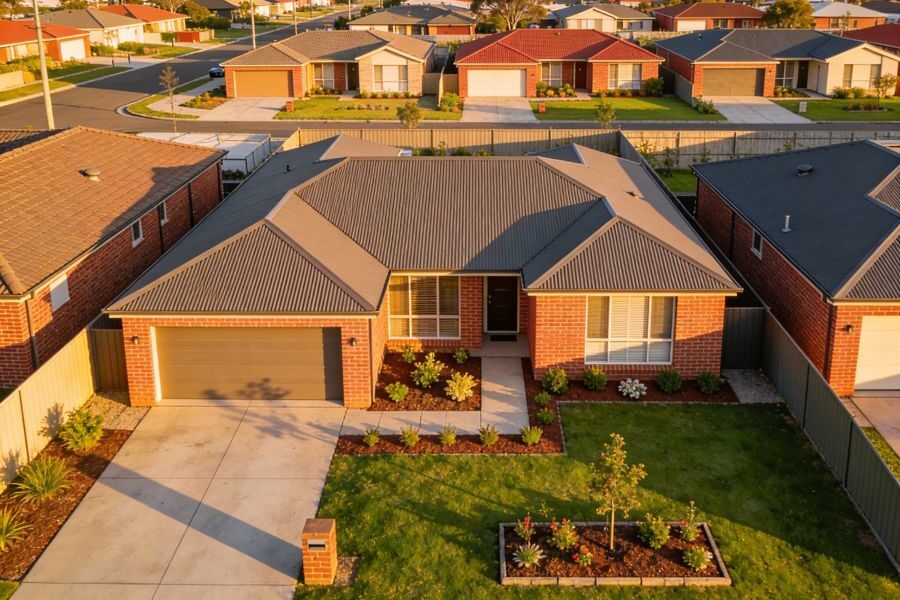
Approvals describe intent, not delivery. The cost of building has outrun what the market will pay. And the country has quietly capped how many homes it can build at any one time. Three things we are getting wrong, from the inside.
Australia is in the middle of a serious conversation about housing. How many homes we are building, and how quickly, has moved from an industry concern to a national one. Affordability, migration, productivity and the future of our cities all run through it.
What follows is an attempt to add some clarity from the inside. Three things are happening at once. The metric we use to track progress is not the metric that matters. The cost of building has quietly outrun what the market will pay for the result. And the total amount of housing the country can have in production at any one time is capped by a mechanism most people have never heard of. Each is fixable. Together they explain why the political claim and the lived reality keep drifting apart.
1. We are measuring the wrong thing
The National Housing Accord, agreed by all levels of government, set a target of 1.2 million new homes over the five years from July 2024. Meeting it requires roughly 240,000 dwellings to be completed each year. The most recent data from the National Housing Supply and Affordability Council shows around 219,000 homes built across the first five quarters of the agreement, against a required pace closer to 280,000 [1]. Master Builders Australia now forecasts 1,034,000 starts over the full five-year period, more than 166,000 below target [2]. No state or territory is on track. The most optimistic projections see the national target reached around June 2030, a year after the deadline; some jurisdictions are tracking several years beyond that [1].
Despite this, the figure most often quoted in headlines, ministerial statements and quarterly updates is dwelling approvals. When the Australian Bureau of Statistics reports that around 18,000 dwellings were approved in a given month [3], that figure represents council permission to proceed. It is a useful early indicator. It is not the same thing as a home being delivered.
Quite a lot sits between the two. Finance must be locked in. Materials must be procured in a market where lead times remain unpredictable. Trades must be scheduled against a well-documented skilled labour shortage. Site conditions, weather, design variations, contractual disputes and an elevated rate of builder insolvency all have to be navigated before keys are handed over. ABS data shows that the average time to build a new detached house in Australia rose by approximately 50 per cent between September 2019 and June 2024, from 6 months and 3 weeks to 9 months and 4 weeks; more recent figures suggest a modest easing as supply chains have stabilised, but build times remain materially above pre-pandemic norms [4]. That alone changes the relationship between an approval and a completion in a way that older policy frameworks did not anticipate.
Approvals also include projects that will never proceed in their original form. They get extended, redesigned, sold or quietly abandoned. Multi-unit approvals in particular often sit on the shelf because the development cannot be made to stack up financially. Treating approvals as a proxy for supply lets the conversation drift away from the metrics that matter: completions, commencements, conversion rates from approval to commencement, and time from approval to occupancy. Those numbers describe the homes people actually move into, and a public conversation built around them would be a more honest one.
2. The cost of building has outrun what the market will pay
Underneath the measurement question sits a structural shift. In many parts of Australia, it now costs more to build a new home than to buy an equivalent established one.
Anyone running feasibility on a new home in 2026 is working with a different cost base than they were five years ago. The Cordell Construction Cost Index, published by Cotality (formerly CoreLogic) and the most widely cited measure of the cost to build a typical new dwelling in Australia, sits around 30 per cent above pre-pandemic levels, with annual growth currently running below the long-run trend but on a base that has not come back down [5]. The industry’s standard cost reference, Rawlinsons, tells the same story across its annual updates: residential rates per square metre in the major capitals have lifted to a level that few builders or developers in 2019 would have recognised [6]. These benchmarks describe the construction line only. They do not include any of the other costs a developer or owner has to wear to get a finished home onto a block of land.
A practitioner’s feasibility builds the total delivery cost in layers. The construction cost is the headline figure, the per-square-metre rate multiplied by built area. On top of that sit the site-specific costs the headline rate excludes: earthworks, retaining, services connections, driveways, fencing and landscaping. Then the statutory layer: council and state government charges, developer contributions and infrastructure levies, which on a new lot in a growth corridor routinely run to tens of thousands of dollars before a slab is poured. Then finance: interest on construction drawdowns and holding costs across a build that, post-pandemic, takes materially longer than it used to. Then time risk: contract variations, weather days, trade availability and the elevated rate of subcontractor and head-contractor insolvency that has run through the sector since 2022. Then transaction costs at the back end, principally stamp duty, GST treatment and conveyancing on the buyer side. By the time those layers are added on top of the construction figure, a modest detached home on a typical block in Sydney or Melbourne is comfortably above a million dollars all-in before any premium finishes are chosen. In a number of growth corridors, that all-in cost of building new now exceeds the price of an equivalent established home nearby on the open market. That is the equation that is breaking new supply.
This changes every incentive in the market. Buyers comparing a new build to a comparable established home often choose the latter on price alone. Developers running feasibility on the next stage of an estate see numbers that do not work without sale prices the market is unlikely to support, and shelve the project. Builders weighing whether to grow look at compressed margins and elevated insolvency rates and reasonably stay small.
Materials and labour, both of which have settled at a permanently higher base since 2020, get most of the airtime, but the fuller picture is broader:
- Holding costs have grown. Higher interest rates and longer build times mean every project carries more financial drag from finance drawn to occupancy.
- Regulatory cost has accumulated layer by layer. Energy efficiency, accessibility, fire and cyclone compliance and other reforms are each defensible on their own merits; their cumulative impact on the cost of producing a home is rarely measured in the round.
- Government charges and developer contributions on new lots in growth areas now add tens of thousands of dollars per dwelling before construction begins.
- Stamp duty, GST and the broader tax treatment of new housing sit unevenly compared with the trading of existing housing.
- Approval and connection timeframes turn months of certainty into years of carry on the developer’s balance sheet.
Each is treated as a separate policy lever, often by separate departments at different levels of government. What is missing is a single view of the cumulative cost of bringing one additional home to market in Australia today, and a clear sense of who is responsible for keeping that cost in check. The implication matters. Demand-side measures such as buyer grants and concessions can ease individual access to the market, but if the cost of producing a new home exceeds what the market will pay, additional demand simply lifts prices on the existing stock. The supply problem sits on the cost side of the equation.
3. We have capped our own capacity, and almost no one is talking about it
The third constraint is the one most outside the industry have never had reason to think about. To carry out residential building work above prescribed thresholds for an owner in Australia, a licensed builder is generally required to take out home owners warranty insurance, sometimes called home building compensation cover, before contracting the work. The scheme is known as the Home Building Compensation Fund (HBCF) in New South Wales, the Domestic Building Insurance scheme in Victoria, the Home Warranty Scheme in Queensland, and by similar names elsewhere [7][8][9]. The thresholds, exemptions and exact mechanics vary by jurisdiction, and some segments of higher-density work fall outside the scheme entirely, but the function across schemes is the same: the cover protects the homeowner if their builder dies, disappears or becomes insolvent during the build or within a defined defects period afterwards. The dynamic that follows is most visible in detached and low-rise residential construction, the segments where these schemes most consistently bite and where the bulk of the country’s new homes are delivered.
The fundamentals of these schemes are sound, and worth defending. They protect families from catastrophic loss. They impose financial discipline on the businesses entrusted to build the largest single asset most Australians will ever own. They have, in principle, helped lift the standard of who is allowed to operate in residential construction. The intent of these schemes, to ensure stronger and more accountable building businesses, is one I support.
Because the insurer is taking on real risk, builders seeking eligibility are assessed for financial capacity, either through automated scorecard review or, for higher-risk or larger profiles, manual underwriting. Two numbers come out of that assessment. The first is Adjusted Net Tangible Assets (ANTA), a measure of the genuine equity in the business after intangibles and certain related-party balances are stripped out and remaining assets are weighted to reflect a fire-sale recovery position. The second is the Open Job Value (OJV) component of the builder’s open job limits, the maximum total contract value of work the builder is permitted to have under construction at any one time. As an industry guide, NSW guidance benchmarks ANTA at around 3 per cent of assumed turnover, with premium discounts of up to 30 per cent available where ANTA sits comfortably above that level, and constraints applied below it [7]. The detail differs across states, but the underlying logic is broadly consistent: stronger ANTA earns a higher OJV, thinner ANTA holds the limit down.
Here is the part that should make policymakers sit up. The total amount of detached and low-rise residential construction that can physically be in progress in a state at any given moment is, in practice, bounded by the sum of every licensed builder’s OJV across that segment. Land release, planning reform and demand-side support all matter, but they work on different parts of the system. None of them lifts the production ceiling itself; they feed pipeline into a capacity envelope that is set elsewhere. To lift the rate of delivery, a state must either grow the pool of licensed builders, lift the OJV of the builders that already exist, or both. There are narrow exceptions at the margins, owner-builders, certain higher-density work that falls outside the scheme, projects insured under bespoke arrangements, but they do not displace the dominant constraint that determines how much housing the country can have under construction at once.
The system is not failing because the principle is wrong. It is failing because of a gap the principle alone cannot close. Builders are licensed and assessed primarily on construction capability, and rightly so. The OJV they are then granted, however, is a financial measure, drawn from financial statements interpreted by underwriters who think like financial professionals, and increasingly by automated credit-bureau scoring on top of that. The assistance, training and support that small to medium builders actually receive in business strategy, financial structure, balance sheet management and how to present a building business in a way an underwriter will reward is thin. Many genuinely capable builders find themselves capped well below their operational ability, not because they cannot deliver homes, but because no one ever taught them how to build the balance sheet the system requires alongside the houses. That gap, between the business and financial education builders need and what they actually receive, has become a widespread brake on small to medium builders growing to the next level. It is one of the quieter reasons the country’s collective OJV ceiling sits lower than it could.
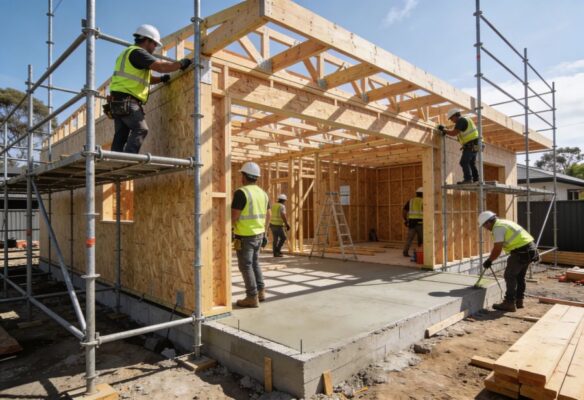
(image: AI generated via freepik)
Lifting the ceiling, the right way
Recognising the ceiling for what it is points to a policy lever that has been largely absent from the supply conversation, and that complements rather than replaces the home owners warranty system.
Government could provide a targeted guarantee that supplements the ANTA of eligible small and medium builders, allowing underwriters to lift their OJV without the builder having to first accumulate the equity organically. The guarantee would be conditional on solvency tests, build quality history, licensing standing and ongoing reporting, and would sit alongside, not replace, the underwriter’s own risk assessment. The underwriter still prices the risk; government backstops a defined portion of the equity that supports the limit.
Why the usual small-business tax measures do not help builders
It is tempting to assume that standard small-business tax measures, particularly the instant asset write-off and accelerated depreciation, would also help residential builders grow. They would not, and the reason is worth understanding because it explains why generic tax relief keeps missing the mark in this sector.
These measures work by allowing a business to bring forward deductions, which reduces taxable income and therefore the tax paid. For most small businesses, that produces a clean cash benefit and is genuinely useful. For a residential builder, it produces a contradictory result. The faster a deduction flows through, the lower the reported profit on the profit and loss statement. Lower profit means lower retained earnings. Lower retained earnings means lower equity on the balance sheet. Lower equity means lower ANTA. Lower ANTA means lower OJV. The very tool that gives the builder a short-term cash boost simultaneously reduces the financial capacity their underwriter is willing to support, which reduces the number of homes they are permitted to have in production.
In practical terms, a builder who uses the instant asset write-off to invest in plant and equipment can find themselves better resourced operationally and worse off in OJV terms in the same financial year. The supply ceiling tightens at exactly the moment the business is trying to grow. This is not a flaw in the tax measures; they were designed for industries with different financial gating. It is a flaw in assuming they translate cleanly into residential construction. They do not.
What would actually work
Industry-specific support is needed, and it should be designed with ANTA in mind from the outset, not in spite of it. Several mechanisms would deliver real working capital without eroding the equity base underwriters look at:
- Direct cash grants to qualifying residential building companies, tied to delivery milestones such as completions or starts above an agreed baseline. Properly accounted for, a grant flows through to revenue or other income, supports profit, and therefore strengthens rather than weakens ANTA.
- Targeted, industry-specific tax offsets or rebates that reduce the tax payable without reducing reported profit. A refundable credit applied below the profit line gives the builder cash without compressing the equity calculation that drives their OJV.
- Payroll tax concessions linked to delivery thresholds, which reduce a non-deductible cost burden, lift margin, and lift ANTA over time.
- Counter-cyclical financing arrangements, where government participates in working capital facilities on a partial-guarantee basis at concessional cost, freeing the builder’s own cash to remain on the balance sheet.
A modest investment in genuine business and financial education for participating builders, delivered alongside the package, would help turn the bridge into permanent capability. The objective is not a permanent subsidy. It is a transitional bridge that uses the government’s balance sheet, paired with industry-appropriate working capital support and better business education, to unlock private delivery capacity that already exists.
The reason this is worth taking seriously is the scale of capacity it could unlock at modest fiscal cost. The HIA-Colorbond Housing 100 Report shows Australia’s largest 100 residential builders delivered 64,407 homes in 2024/25, around 36 per cent of the new home market [10]. The other 64 per cent, roughly 114,000 starts, comes from the small and medium builder segment that sits below the Housing 100 list. Master Builders Australia’s industry profile notes that the overwhelming majority of building and construction businesses are small to medium enterprises [11]. This is the segment the OJV ceiling is hardest on, and it is also the segment best placed to convert lifted capacity directly into additional homes.
Now consider what an ANTA guarantee could do across that segment. If government backing enabled even a portion of small and medium builders to lift their OJV by the equivalent of three to five additional homes each, the system-wide gain runs into the tens of thousands of homes in active production at any one time. As an illustration: 3,000 participating builders with an extra three homes of OJV each is 9,000 additional homes; 4,000 builders with an extra four is 16,000; 5,000 builders with an extra five is 25,000. None of these scenarios assumes the entire SME segment participates. They simply illustrate that a measured uplift, applied across the segment that already delivers nearly two-thirds of the country’s new homes, scales quickly.
A few caveats matter. This is a measure of homes in active production at any one time, not annual completions; the flow of finished homes depends on average build duration. Not every additional OJV slot will be taken up immediately, and not every builder will qualify under sensible solvency, quality and licensing tests. But even adjusting for those frictions, the order of magnitude is clear. Unlike grants to buyers, which lift demand against fixed supply, a measure of this kind directly raises the system’s collective production ceiling, and gives an industry that has absorbed an unusual run of insolvencies the breathing room to rebuild balance sheet strength on its own terms.
A view from the industry
From the perspective of someone who has spent a career in residential construction, the housing supply debate can feel oddly disconnected from the day-to-day reality of delivery. Policy moves in announcements; sites move in slabs poured, frames stood, trades booked, and contracts that either land in profit or do not.
Australia is not short of people who know how to build homes. It is short of three things. A measurement system that tells the truth about delivery, not intent. A grip on the cumulative cost of producing a home in this country, and the political will to manage it. And a way to lift the collective capacity ceiling that the home owners warranty system, sound as its principles are, currently imposes on the industry charged with delivering the country’s housing.
None of these is a single reform or a single announcement. Together, they are how the country starts to deliver the homes the next decade will need.
References
[1] National Housing Supply and Affordability Council, Quarterly Report, March 2026. https://nhsac.gov.au/reports-and-submissions/quarterly-report-march-2026 Five-quarter completion total, jurisdictional pace and expected Accord completion dates.
[2] Master Builders Australia, Australia moves further away from National Housing Accord target. https://masterbuilders.com.au/australia-moves-further-away-from-national-housing-accord-target/ Forecast of 1,034,000 starts over the five-year Accord period and projected shortfall.
[3] Australian Bureau of Statistics, Building Approvals, Australia (latest release). https://www.abs.gov.au/statistics/industry/building-and-construction/building-approvals-australia/latest-release Monthly dwelling approvals data, seasonally adjusted and trend series.
[4] Australian Bureau of Statistics, Home building through the pandemic (feature article). https://www.abs.gov.au/articles/home-building-through-pandemic Average new house completion time rose 50.0 per cent from 2.2 quarters in September 2019 to 3.3 quarters in June 2024.
[5] Cotality (formerly CoreLogic), Cordell Construction Cost Index (CCCI), Australia. https://www.cotality.com/au/resources/downloads/cordell-construction-cost-index-ccci Quarterly index tracking the cost to build a typical new dwelling in Australia; residential construction costs sit around 30 per cent above pre-pandemic levels, with annual growth of 2.5 per cent in the year to December 2025.
[6] Rawlinsons, Australian Construction Handbook and Construction Cost Guide (annual editions). https://www.rawlhouse.com.au/ Australia’s longest-running construction cost reference, compiled by Rawlinsons Quantity Surveyors and updated annually with quarterly revisions; the standard square-metre rate benchmark used across the Australian construction industry.
[7] icare NSW, Home Building Compensation Fund — Eligibility, ANTA Fact Sheet and Open Job Limits. https://www.icare.nsw.gov.au/builders-and-homeowners/builders-and-distributors/am-i-eligible-for-hbcf Background on HBCF eligibility, the role of Adjusted Net Tangible Assets and Open Job Limits (which include the Open Job Value).
[8] Building and Plumbing Commission (BPC), Domestic Building Insurance (DBI), Victoria. https://www.bpc.vic.gov.au/domestic-building-insurance Victoria’s equivalent home owners warranty scheme; required by builders for domestic projects valued over $16,000. Responsibility for DBI transferred from VMIA to the BPC on 1 July 2025.
[9] Queensland Building and Construction Commission, Home Warranty Scheme. https://www.qbcc.qld.gov.au/home-owner-hub/queensland-home-warranty-scheme Queensland’s statutory home warranty scheme; compulsory for residential construction work valued at more than $3,300.
[10] HIA-Colorbond Steel Housing 100 Report 2024/25, Housing Industry Association. https://hia.com.au/our-industry/newsroom/economic-research-and-forecasting/2025/09/hia-reveals-australias-largest-home-builders-for-202425 Top 100 builders delivered 64,407 homes (36 per cent of new home market) in 2024/25.
[11] Master Builders Australia, industry profile and submissions to government. https://masterbuilders.com.au/ Industry profile noting the predominance of small and medium enterprises in Australian building and construction.
Brad Caldon is a licensed builder and registered building practitioner with nearly two decades of experience delivering residential construction and property development across NSW. He holds a NSW Home Builder Licence, is registered across Class 1 to Class 9 buildings, and holds a Bachelor of Construction Management (Building) (Honours) from the University of Newcastle.
He directs two businesses: Wattle Court Mid-Coast, a boutique residential builder operating across the Mid-Coast and Port Macquarie-Hastings LGAs, and CALDON™, a private development vehicle active from the Mid North Coast through to Sydney, Newcastle, Coffs Harbour and Tamworth. His work spans the full development cycle: land acquisition, feasibility modelling, debt and equity structuring, procurement, contract management, construction delivery and financial close.
Brad writes from the perspective of someone who works within these systems every day, bringing the financial, contractual and operational realities of construction and development into public conversation. Where most industry commentary is written from the outside looking in, his is grounded in live decisions, real balance sheets and the mechanics that determine what gets built and what doesn’t.





Join the conversion
Don't:
Do: